
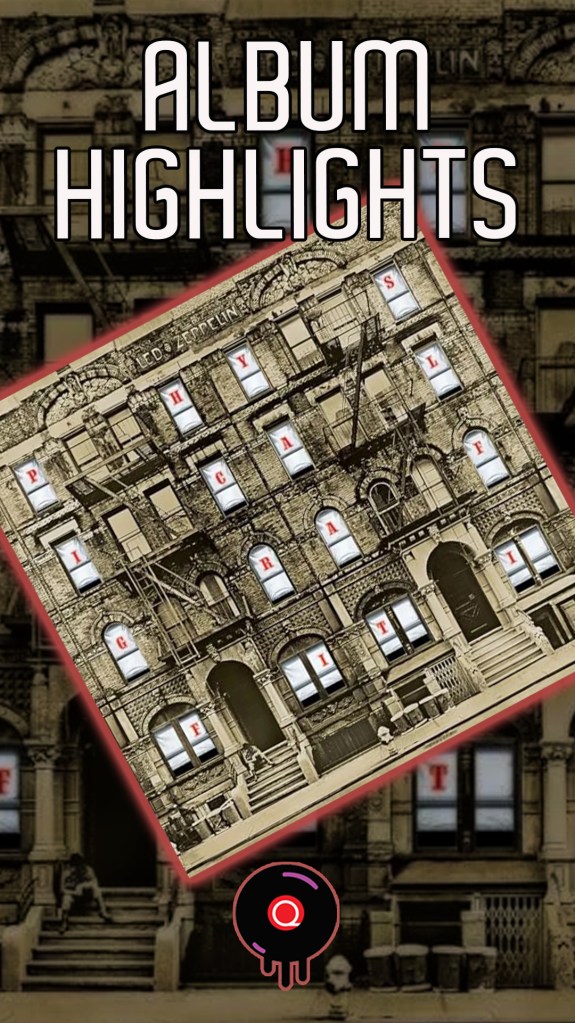
If you’ve ever wondered what it would sound like if rock music could smash through every wall of reality, then Led Zeppelin’s Physical Graffiti is your answer. Released in 1975, this double-album is nothing short of a sonic behemoth—a sprawling, chaotic, and utterly perfect testament to everything that made Zeppelin the untouchable gods of rock ‘n’ roll. It’s not just an album; it’s a war cry. A declaration. An experience that gets under your skin and leaves a trail of destruction in its wake.
We start with the colossal “Kashmir”—a track so legendary it’s practically a genre unto itself. With its hypnotic, droning rhythm and swirling arrangements, it’s like Zeppelin grabbed a handful of desert sand, turned it into sound, and created a landscape that’s both otherworldly and undeniably grounded. The song moves like a mountain, unrelenting, yet somehow endlessly fascinating. It’s the sort of track that makes you want to drop out of society and wander the earth with no real destination except for the thrill of the journey itself.
Then, there’s “In My Time of Dying”—an unholy blues masterpiece where Zeppelin channels the very spirit of the Delta, drags it through a fire, and gives it a hard rock makeover that feels like a raw wound you can’t stop picking at. Every note cuts through you, and every scream from Plant feels like the last breath of a soul destined for something much bigger than this mortal coil. It’s loud. It’s ferocious. And it’s perfectly Zeppelin.
“Trampled Under Foot” rolls in next, a track that makes you question whether Zeppelin was ever really a “rock” band, or if they were just a bunch of musical anarchists bent on dismantling genres with a relentless, funky groove. It’s not just about the riffs—it’s about the attitude, the swagger, the feeling that you’re witnessing a band that has no intention of letting anyone tell them what they can and can’t do.
But don’t get too comfortable in your rock ‘n’ roll heaven, because Physical Graffiti also pulls you into softer, more ethereal territory. “Bron-Yr-Aur” is like a trip through the looking glass, an acoustic fantasy where the band, as always, refuses to do anything by the book. If “Kashmir” is a mountain, “Bron-Yr-Aur” is the quiet stream running at its feet, offering a delicate, almost mystical respite before the next tidal wave of distortion and chaos hits.
And that’s what makes Physical Graffiti so damn great. It doesn’t just sit there. It’s not content to stay in one lane or even one genre. The album jumps from blues to hard rock to funk to folk, each genre injected with a manic dose of Zeppelin DNA that transforms it into something completely their own. One minute you’re ready to fight in the trenches with “The Rover,” and the next, you’re lost in the hazy beauty of “The Song Remains the Same.”
It’s an album that demands to be experienced as a whole. Skip a track, and you might miss the key to understanding what makes Zeppelin tick. Because at its core, Physical Graffiti isn’t just about songs; it’s about the concept of excess. This isn’t a record for the faint of heart. It’s two discs of towering rock, indulgent and unapologetic. It’s a record where every note is drenched in confidence, every riff is an explosion, and every minute feels like the band is rewriting the rules of music itself.
Zeppelin’s magic isn’t in the technical mastery—though that’s certainly part of it—it’s in their relentless need to break down boundaries, to take their music to places no one thought possible. And on Physical Graffiti, they do it with a kind of swagger and abandon that’s both exhilarating and terrifying. This is a band that doesn’t just play rock music; they are rock music.
So, if you’ve never heard Physical Graffiti, here’s the challenge: try not to get lost in it. Try not to get sucked into the vortex of sonic ecstasy it creates. Try not to feel like you’ve just been transported to another world. Because once you step into the realm of Physical Graffiti, there’s no turning back. It’s a record that’ll haunt you, inspire you, and leave you breathless in the best way possible.
In the end, that’s why Physical Graffiti matters. It’s not just a record. It’s a journey. A trip. A testament to everything that made Led Zeppelin the titans of rock—and why, in 1975, they were the last band standing in a world full of pretenders.
 QuickSpins
Leave a comment